Tuesday, 13 December 2016

Typography Analysis

Cover

  • Masthead:
    • Style - Blocky and bold
    • Range - One font
    • Size - 1/6th the page height
    • Colour - Red
    • Case - Capitals
  • Cover Lines:
    • Style - Straight and bold / thin
    • Range - Two fonts
    • Size - 1/16th the page height / 1/10th the page height
    • Colour - White / Red / Black
    • Case - Capitals/Sentence Case
  • Puffs/Pugs:
    • Style - Straight and bold
    • Range - One font
    • Size - 1/16th the page height
    • Colour - White
    • Case - Capitals
  • Small Print:
    • Style - Straight
    • Range - One font
    • Size - 1/32 the page height
    • Colour - Black
    • Case - Sentence Case
Contents
  • Headings:
    • Style - Straight and bold
    • Range - One font
    • Size - 1/8th the page height
    • Colour - Red w/ white outline / White on a black bar
    • Case - Capitals
  • Subheads:
    • Style - Straight and bold
    • Range - One font
    • Size - 1/16th the page height
    • Colour - White on black bar
    • Case - Capitals
  • Small Print:
    • Style - Straight and thin 
    • Range - One font
    • Size - 1/32 the page height
    • Colour - Black
    • Case - Sentence Case
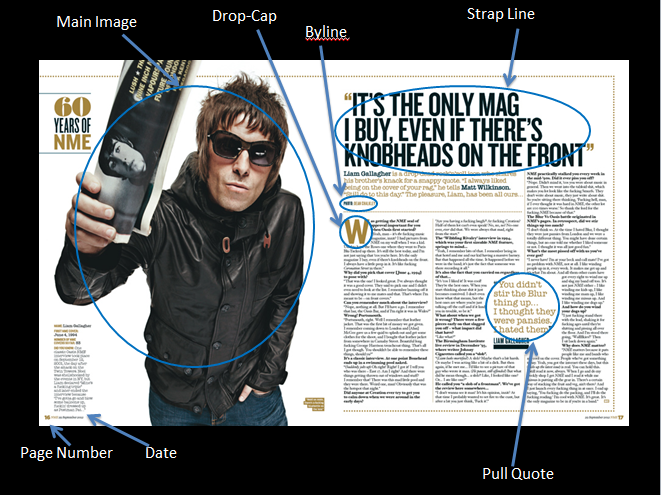
DPS
  • Headings:
    • Style - Bold and straight
    • Range - One font
    • Size - 1/13th the page height
    • Colour - Black
    • Case - Capital
  • Subheads:
    • Style - Small and bold
    • Range - One font
    • Size - 1/78th the page height
    • Colour - Black
    • Case - Sentence Case
  • Byline:
    • Style - Small and italicised
    • Range - One font
    • Size - 1/78th the page height
    • Colour - Black
    • Case - Sentence Case
  • Pull Quotes:
    • Style - Typewriter style
    • Range - One font
    • Size - 1/39th the page height
    • Colour - Gold
    • Case - Sentence Case
  • Article Copy:
    • Style - 
    • Range - 
    • Size - 
    • Colour - 
    • Case - 
  • Small Print:
    • Style - Typewriter style
    • Range - One font
    • Size - 1/78th the page height
    • Colour - Black
    • Case - Sentence Case

Initial Design Ideas


Many ideas were proposed for the main image, some breaking and some conforming to genre conventions. The first idea conformed to genre conventions by being at eye-level and showing the model facing the camera with their arms crossed. This conforms to genre conventions as it connotes rebellion, which is an applicable theme to indie, this can also be associated with Osgerby's 1998 theory stating that " Youth is trouble, youth is fun". A secondary main image idea would have been a high angle close up of the model. This would have played on the downward social comparison gratification of Blumler and Katz' uses and gratifications theory as it would show the model from above, giving connotations of them being lesser than the reader. This is also relative of Keith Gandal's 2007 theory of audiences being drawn to 'rags to riches' stories.


There were multiple titles that were considered for this magazine such as; Just Rock, Amp(ed), and Heavy Roller. The name decided upon name, Amp'd, was derived from Amp(ed) as it was believed to be the most appropriate for the given genre of the magazine, that being indie rock. The name Amp'd has appealing properties that would resonate with a younger audience specifically between 15-24 years as it uses a contraction apostrophe to replicate the way many people of a younger audience speak in terms of removing 'unnecessary' letters from certain words, such as how the 'e' is removed from "Amped" to produce "Amp'd".

Friday, 9 December 2016

Font Ideas/Usages


This is the font I was planning to use for my masthead. I have chosen this font as it suites the style of the type of magazine I am aiming to create, that being indie rock. The font is deliberately blocky and bold as it connotes masculinity, which is prevalent within the rock genre. The way the masthead is spelled is also deliberate in order to further relate it to the rock genre.


This font would work well as a basic type face for my magazine as it is very easily read and follows the general conventions of the indie rock genre. The font is made to appear as if it were from a typewriter which relates the the indie genre as many independent artists have low production costs due to their independence from a large producer. So by using a typewriter-esque font it gives the appearance that the media does not have access to something such as a computer which furthers the connection to the indie genre.


Similar to Bebas Neue, Lemon Milk, would make a suitable font for cover lines due to it's bold and straight-edged look. This makes it stand out more than other fonts and will help contrast it from the background it's on and any surrounding elements of the magazine.

Tuesday, 15 November 2016

Representation & Stereotypes

   This cover of NME supports Mulveys theory that women, in media, are objectified for 'the male gaze'. The mise-en-scene gives evidence to support this as the main image contains a young female artist, Lily Allen, wearing a shirt with a low cut neck. This supports Mulveys theory as her attire could be seen as revealing as it shows skin unnecessarily. This, with the connotations of the use of red being masculinity, implies that the magazine is pandering towards a primarily heterosexual male audience.
   The lexis of the cover also somewhat disrupts Mulveys theory as its states "Lily Allen takes on the world" which implies a sense of masculinity and dominance over a given situation that is not stereotypically linked to the female gender.
   In relation to my own music magazine cover, contents page, and double page spread, I may use and image that disrupts this theory as it could be seen as more daring and interesting.
     This cover of Rock Sound magazine supports Hedbridges theory of youth consisting of two main factors, "youth as fun" and "youth as trouble,". The cover supports this as it clearly shows at least one of sides of this theory. Those on the cover of this magazine fit the mise-en-scene stereotype for youth as they are covered in tattoos, wear snap-back caps, and t-shirts with bold styles and patterns, as well as having very generic hair styles for 'rebellious youth'. As they fit conventions for a rebellious group they fit one side of Hedbridges theory where they represent the "youth as trouble" portion.
     From this I can learn that I may be able to represent this theory in a way that could positively resonate with a younger audience in a way that would encourage viewership.


Friday, 4 November 2016

Audience Research & Profile

Magazine producers use multiple methods to identify their target audience. One of these methods is to isolate what types or groups of people would be interested in their product. This can be done through using common stereotypes to assume or understand what that group would enjoy or want. By pinpointing what is special about their product they can see what correlates to one or more groups in terms of interest. Important features of an audience that a company would have to consider are:
  • Age
  • Gender
  • Class
  • Location
  • Income
  • Interests
  • Religion
There are two main ways of identifying a target audience and that is through the analysis of demographics and psychographics. Demographics are more common and show factual data and information such as age, gender, and location. Psychographics are very different and instead show an audiences personality, attributes, interests, and lifestyle.

As the genre of my product will be rock I have decided to analyse audience profiles of the average reader of a rock magazine. The average profile publishers state their audience fits is:
  • Men
  • 16-30 years old
  • Straight
  • White
  • Extrovert
  • Working Class
From this information I can infer that my audience would be under middle-age, male, open to daring design, and looking for something affordable. I can use this information for when I create my product as it will allow me to shape my magazine to better fit, attract, and entertain a more specific audience rather than blindly hoping to catch someones attention. The psychographics of an audience are slightly harder to pin down and identify than demographics. There are multiple ways of classifying an audiences psychographics, the Young & Rubican method categorises people into 7 sets:
  • The Aspirer
  • The Explorer
  • The Reformer
  • The Mainstream
  • The Struggler
  • The Resigned
  • The Succeeder
Each of these sets has its own defining features based on how they would typically act in life and allows for easy classification of an audience to find out what type of product they would be interested in. For instance, 'The Reformer' is the type of person that values their own opinion over being told what to do, fairly anti-materialistic, and seen as intellectual. From this it can be inferred that someone fitting this group would be only interested in what they find useful or interesting and will not simply follow others and be corralled by the newest and shiniest. Those interested that fit the above profile are the typical audience for the rock genre therefore are most likely going to be the audience for my product. This means that 'The Explorer' could potentially be the set best fitting for my audience as they best respond to brands with instant effects and constantly seek out new thrills.

Tuesday, 1 November 2016

Photography Task: Composition & Framing


Moderately lit, single source behind camera
   to camera right

Casual mise-en-scene

Over-the-shoulder shot, eye-level

Outside, mid-day, high obstruction to camera
   right, low obstruction camera left

Subject has back to camera, head tilted to camera
   left
-------------------------------------------------------
Brightly lit, single source directly behind camera

Casual mise-en-scene

Medium close up, direct address

Outside, mid-day, high obstruction behind
   subject

Subject facing camera, back to wall, head tilted
   slightly forward


-------------------------------------------------------

Dimly lit, single source ahead of camera,
   partially obstructed

Casual mise-en-scene, school rucksack

Medium close up, eye-level

Outside, mid-day, in shade

Subject posture facing away with head turned to
   face camera, hands sprawled comically.
-------------------------------------------------------

This exercise has taught me the importance on depth of field, rule of thirds, and lighting. In future I will most likely use what I have learned to impact my photoshoots through the proper and effective use of these three features. Depth of field and rule of thirds are both useful to help push focus of the reader onto or away from an element of the image. Proper use of lighting will allow me to accentuate certain aspects of the image, which can also help draw focus.

Tuesday, 18 October 2016

Task 14: Sub-Genre Research (Hip Hop/Rap)


Hip Hop/Rap


     Hip Hop/Rap is a music genre that originated from African-American youth in the US during the 70's that is notably rhythmic and always accompanied by rapping, a form similar to singing but similarly rhythmic and in rhyme. Hip Hop contains many subcultures that developed throughout different areas of the US such as 'gangsta', West Coast, East Coast, 'crunk', and alternative hip hop. Some popular Hip Hop artists include 'Ice-T', 'Notorious B.I.G.', and 'Run-D.M.C.'. The primary audience for Hip Hop is youths between the age of 15 - 25. It is often classed as a platform for protest as it was widely used to allow people to question authority and is also used as a tool for cultural, political, and social empowerment especially among minorities.

     Production values of Hip Hop magazines vary greatly. Many artists of the Hip Hop genre believe that they should portray an image similar to that of what the creators of the genre had, that being one of relative poverty, and so dress accordingly in ragged, baggy clothing. Others, such as the example above believe they should flaunt their wealth in order to appear more powerful, similar to what the youth believe an authority figure to look like.

     The Hip Hop culture as a whole is somewhat aggressive and many glorify violence, this has a clear effect on the lyrics, attire, and representation of themselves. The colour red connotes exactly this, violence, power. Other colours such as black are also commonly used on Hip Hop magazines and generally within that culture as well as carrying connotations of power and authority.

Task 14: Sub-Genre Research (Indie)

Indie
     Indie (Independent) music is a title used to describe a multitude of bands or artists that simply do not have a major record label to produce their music and instead produce it independently. Indie music both is and is not necessarily a genre as it is more off a term to describe bands that follow the aforementioned rules. Because of this there are eccentric amounts of 'fusion' genres with Indie, and it is more often than not that bands will be referred to as 'Indie-Rock' or 'Indie-Pop' than just Indie. The primary target audience for the Indie 'genre' are. Popular Independent artists are The Killers, Arctic Monkeys, and Oasis.


     Many Indie artists have low production values, primarily relating to them either not having a label company for financial support, or that their label company is very small or poor themselves. Because of this, independent artists often have their own very unique look or style to differ themselves from other artists, and conventions of other genres. Often these appearances are for sheer shock value in an attempt to gain fame or support, this implies that they will be bright and eye-catching such as the example above.


     A popular assumption made about Indie artists is that they pander more towards younger audiences of those in their teens, roughly 15 - 23, most likely made due to their bright and often dishevelled appearances that could be seen as relatable by those in that age group. People in that age range are also very often one of the most berated by modern media for many reasons; being portrayed as uneducated, drug abusers, alcoholics, and violent criminals. This would imply that they are within an age range that would seek acceptance from others that can be given, or seen to be given, by this genre of music as it is seen as relatable, which would explain why independent music has become so popular within recent years especially.

Task 14: Sub-Genre Research (Heavy Metal)

Heavy Metal

Heavy Metal originated from certain sub-genres of rock and is characterised by its 'thick', distorted sound with the general intention of loudness, and general association with aggression and masculinity. The primary target audience for Heavy Metal is that of a young audience, generally men, between the ages of 18 & 25. Heavy Metal is known to be classed as a "subculture of alienation", implying a strong sense of devotion and self-reliability from their fans. Popular artists would be bands such as Slipknot, Metallica, and Black Sabbath.

Most Heavy Metal magazines have a varying layout for each magazine that is usually very messy in composition. The covers very often feature images of bands or singers from the Heavy metal genre with either the name of their band, or an incorporation of it into the main cover line. The fonts used are usually sans-serif, simple, and straight edged; except for in some cases where a much more gothic font is used, but only for the masthead and not for cover lines or headings/sub-headings. The primary colour scheme for Heavy Metal magazines usually uses lots of reds, blacks, and whites. The use of the colour red connotes a certain level of masculinity, violence, and rebellious nature that is well associated with  Heavy Metal as a genre.

Somewhat similarly to other music magazines, Heavy Metal magazines are primarily comprised of interviews and reviews of different bands from the Heavy Metal genre. Due to having fairly little variety in substance, most Heavy Metal magazines are often less than 15 pages in length. From the lack of length, it can be inferred that the magazines would not cost a great amount and would be released somewhat regularly, as opposed to seasonally, as certain other magazines do, although those are not often music magazines.

Friday, 14 October 2016

Task 14: Sub-Genre Research (Rock)

Rock
Rock music has multiple sub-genres of varying degrees of difference. Each specific sub-genre is usually created in a separate part of the world to another which leads to different societies and cultures defining Rock music differently to others. Most Rock genres pander to similar audiences in terms of gender and age, but to people in those categories with specific tastes in music. The primary target audience overall, in reference to gender and age, would be middle-aged men between the ages of 25 & 50. This is not to say people outside of this range would not find certain Rock music genres appealing, only that this would be classed as the range where the 'most' appeal would be found. Common examples of famous rock bands would be Green Day, Metallica, or Guns N' Roses.

It can be inferred from a sample of different Rock magazines that there is a common colour palette shared between a great deal of the magazines. Most of them use a great deal of the colour black, with few exceptions, and every single magazine used the colour white either in the masthead or in the main image. These two colours are polar opposites and create a great contrast between two objects, their use in these magazines is usually to bring the readers attention to the masthead as it contrasts with the dark background.

The font style used in most Rock magazines is curved and connotes a casual lexis. The layout of the magazines is also very similar to other magazines where the masthead is at the top of the cover and usually, but not exclusively, overlaying the main image which almost always consists of either a singer or an entire band.


Friday, 7 October 2016

Task 14: Sub-Genre Research (Pop)

Pop

Pop has two considerable target audiences as it is such a varied genre, despite it being found to be declining in its diversity. Arguably, the primary audience is a younger, more teenage audience. Artists such as Little Mix and One Direction would fall under the category of pandering to this audience. The secondary audience would be similar to the primary, but include an audience of late teens to youngish adults. Artists such as Ariana Grande would pander to such an audience.

Pop magazines aimed at younger audiences are notoriously bright and eye-catching in their use of colours. Neon colours are very popular and almost a staple of this part of the Pop genre.
Pop magazines like this often cater to two different audiences, either just females, or both genders. The layout of these kinds of magazines are usually very messy and spaced out which could connote the feelings or lifestyle of that kind of audience where they are very messy and non-organised.

The font of Pop magazines is, more often than not, very straight edged and sans-serif. The font in the masthead, and sub-headings, is often the same but much more brightly coloured than the text used in the actual magazines stories, this is to grab the attention of the reader as the masthead is different from the rest of the text and may be deemed more interesting. The style of the font could be representative of the content of most Pop magazines as they frequently divulge on gossip and information about the artists rather than simply talk about the music itself although it is not exempt from mention.

Saturday, 1 October 2016

Preliminary Evaluation

The research and planning I did helped me produce an effective product by allowing me to a product that is accurate to genre conventions. This would allow my product to be easily received by a wide audience. My media product uses the forms and conventions of other products of a similar type such as having certain elements commonly seen in most similar media products. My product contains a main image, a main cover line, a masthead, a dateline, and a selling line. These are all very common elements to other popular media products of a the same style, that being a magazine cover.

My media product represents a specific social group of people of any gender between the ages of 13 and 19. This is because my product's primary target audience is college students and the most common age range for students in a college setting is 13-19. My product does not necessarily represent any other social group as there is only a small demographic for the primary audience of popular products similar to mine.

I believe the institution that would produce my product would be a college. This is primarily due to the fact that as it is a college magazine it would be most appropriate for it to be produced by an actual college itself as they would know far more about the target audience of students than most other institutions.

I used bright colours with positive connotations to address and attract my audience. The logo I used and the accent underneath it are both a bright red which is very eye-catching to most audiences. This is important as it means that the first thing most people will look at is the masthead/logo which makes the magazine immediately identifiable for most.

I believe the strengths of my final product are its ease of ability to be identified and its cohesion with most conventions of real media products that are of the same types as my product. 

When I start my main task I may need to improve on my target audience analysis as it may need to be more informative to properly allow the final product of my main task to be as successful as it may need to be.

Friday, 23 September 2016

Preliminary Task 4: Target Audience

The Primary Target Audience for a college magazine is people of any gender from the ages of 11-19. Rarely will college magazines pander to the parents of the students inside the college and but it could be argued that the Secondary Target Audience would be people of any gender and between the ages of 30-50 for the reason that it is entirely possible and most likely a consideration on each colleges part. The Social Grades of both Target Audiences are most likely to be between D and C1. This is subject to change depending on what location or environment the school is in yet it is most likely to be in this range. The D to C1 range includes anyone who has a semi-skilled manual occupation or is in a clerical or junior administrative position.

Similarly to Social Grades, it can be assumed that most of the students that would read the magazine would be in the working class although it is not necessarily always true, such as in the event one of the students families may be in the middle class or above. Furthermore, if one of the students parents were to be in a higher class, then it would be that the secondary audience's Social Grade and class would be very similar to the students at D to C1 or perhaps even D to B, for the Social Grade, and working class to middle class for the secondary audiences class. The inclusion of the B Social Grade means that those in an intermediate managerial or administrative position would be included.

The uses and gratification of the magazine would primarily be cognitive, and possibly affective, and socially integrative. The magazine would assist cognitively due to it relaying information from the college to students and parents alike; affectively as someone could feel emotively, such as prideful or excited at a given piece of information, for or because of someone or something in the college, such as an event; and to fulfil socially integrative needs by giving a common topic for discussion among students or parents. This would most likely apply to both the primary and secondary audiences.

This information lines up somewhat well with a survey I conducted from a broad range of people, yet kept to a small scale. There were a considerable amount more male than females that took this survey, were this to be reproduced it would be favourable to have an equal amount of each gender. The prediction of age being between 11-19 was very accurate as there were no results higher than that boundary. Most of those who took the survey were people who read college magazines at a ratio of 3:1 for people who do read them against those that don't. The rate at which people read college magazines is varied greatly. 2 of the 8 said they read them weekly, 3 out of 8 said they read them monthly, 2 said they did not actually read them, and 1 said they read them 'occasionally'. 

Friday, 16 September 2016

Goward Media AS Cover


This is the magazine cover for the magazine from Worcester College. The cover is a simple main image with a masthead, and a dateline. It does not have any cover lines as it is very plain and open. The dateline is somewhat unique as rather than displaying an actual date it instead displays an obscure holiday, Michaelmas, that takes place on September 29th and marks the day harvest ended and is the day of the Feast of St Michael, a strong biblical figure. The issue number is shown opposite to the dateline and is in the same font and of a similar size.

This gives a good sense of symmetry that could make the magazine appear more attractive and eye-cat These show the intellectual nature of the owners of the magazine and the reader, as well as a possible high acceptance or practise of Christianity or religions in general.

The masthead is very simple and just states the name of the college, "Worcester College" with the word "MAGAZINE" underneath in a smaller font as to not steal attention from the college's title. Its font is curved and sans-serif. This presents a more approachable appearance for the magazine that could juxtapose other elements of the magazine such as the main image and its representations.


The main image shows a man in robes under an archway. Immediately it is clear that the mise-en-scene is of the theme of a college environment, as would be expected from a magazine based in and about a college. The lighting from the inside of the building is dim to further the contrast between the inside of the building and the outside, as well as bringing more attention to the man in the archway. In the foreground there are three obvious objects: a notice board, a stone column, and an artistic seal. These objects all connote an academic and well respected environment. The seal and stone column both connote an ancient history for the location with could represent wisdom in the college community. 


The layout of the contents page for the Worcester College magazine is very different to the cover in that it does not include a main image with overlaying text but rather a small collection of images off-centre and correlating to some of the headings opposite. The format they have used is standard for contents pages and will be seen more often than not as a result.


Another juxtaposition from the cover is that the tones and colours used are much lighter. This is most likely to increase potential readability and to allow for those, even with reading disabilities, to understand the writing.


There is no clear mise-en scene throughout the images used and there is also a varied representation for each image. These both imply the college is a large and varied location as there is no one continuing theme or setting throughout the images and perhaps the college as a whole.

The representations in the images are all fairly standard for a college. None of the shown 'communities' are represented in a specific way and each image is much more of a demonstration than a message itself as each is somewhat generic and shows only typical images of events that would take place in a college such as a student working, and a lecture taking place.


This is the magazine cover for the Cansius College Magazine. The cover is similar to the last on the terms that they are both primarily a main image with very little text otherwise. This magazine cover has no cover lines, but does have a main cover line. The cover also does not have a detailed dateline as it simply says 'Spring/Summer 2016', because it says the season rather than the exact date it can be assumed that he magazine is either a quarterly magazine, or because it shows two seasons, a bi-annualy updated magazine.


The main image of the cover is much more 'friendly' than the previous and features a somewhat academic background with two people of adequate age, who are most likely teachers based on context and dress, instructing two people of a much younger age, who are most likely students also due to context and uniform.


The masthead for the magazine cover is a deep blue, serif font. The colour blue connote intellectualism, calmness, and safety, all important themes of a school or college location. The serif font also implies a sense of academic sensibility as well as having the masthead clip behind the main image implies that the magazine is well known and
so they do not need to display the entire title.


The contents page for the Canisius College Magazine is very different to the last contents page as this version chooses to use a much more visually appealing style by having much more to look at than the previous. It also uses images much more frequently than most other contents pages and is lain out quite differently too. Rather than having a falling list that demonstrates each topic, this magazine decides to instead show a collection of images with a number on them that corresponds to a page number where that story is, and a small description beside them that briefly sums up the story.


Throughout both; the images and otherwise, there is a strong use of a deep blue. This tone, as stated prior, connotes safety, intelligence, and calm. The constant use of it also allows for other colours to attract the readers attention more easily, such as the yellow used in the headings for each story.


All but one of the images is taken from an eye-level angle. This is an angle commonly used to show an equal footing with someone and is used for that exact purpose in this format. It is meant to show that anybody is entirely able to be in their position, which is a very relevant idea for a student in that college that would be reading this magazine.