Wednesday, 19 October 2016
Tuesday, 18 October 2016
Task 14: Sub-Genre Research (Hip Hop/Rap)
Hip Hop/Rap
Hip Hop/Rap is a music genre that originated from African-American youth in the US during the 70's that is notably rhythmic and always accompanied by rapping, a form similar to singing but similarly rhythmic and in rhyme. Hip Hop contains many subcultures that developed throughout different areas of the US such as 'gangsta', West Coast, East Coast, 'crunk', and alternative hip hop. Some popular Hip Hop artists include 'Ice-T', 'Notorious B.I.G.', and 'Run-D.M.C.'. The primary audience for Hip Hop is youths between the age of 15 - 25. It is often classed as a platform for protest as it was widely used to allow people to question authority and is also used as a tool for cultural, political, and social empowerment especially among minorities.
Production values of Hip Hop magazines vary greatly. Many artists of the Hip Hop genre believe that they should portray an image similar to that of what the creators of the genre had, that being one of relative poverty, and so dress accordingly in ragged, baggy clothing. Others, such as the example above believe they should flaunt their wealth in order to appear more powerful, similar to what the youth believe an authority figure to look like.
The Hip Hop culture as a whole is somewhat aggressive and many glorify violence, this has a clear effect on the lyrics, attire, and representation of themselves. The colour red connotes exactly this, violence, power. Other colours such as black are also commonly used on Hip Hop magazines and generally within that culture as well as carrying connotations of power and authority.
Task 14: Sub-Genre Research (Indie)
Indie (Independent) music is a title used to describe a multitude of bands or artists that simply do not have a major record label to produce their music and instead produce it independently. Indie music both is and is not necessarily a genre as it is more off a term to describe bands that follow the aforementioned rules. Because of this there are eccentric amounts of 'fusion' genres with Indie, and it is more often than not that bands will be referred to as 'Indie-Rock' or 'Indie-Pop' than just Indie. The primary target audience for the Indie 'genre' are. Popular Independent artists are The Killers, Arctic Monkeys, and Oasis.
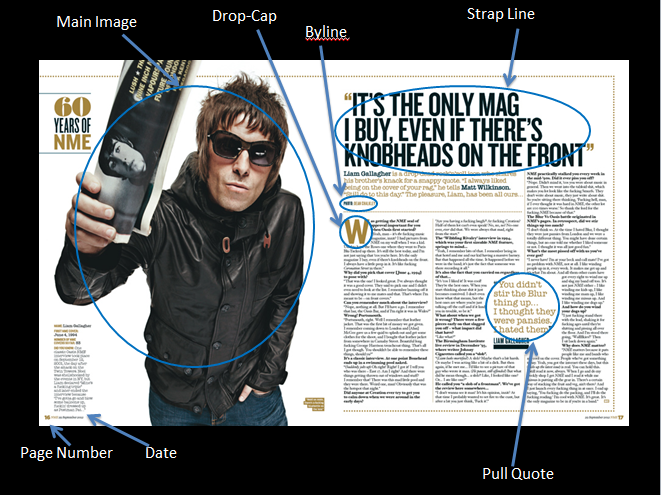
Many Indie artists have low production values, primarily relating to them either not having a label company for financial support, or that their label company is very small or poor themselves. Because of this, independent artists often have their own very unique look or style to differ themselves from other artists, and conventions of other genres. Often these appearances are for sheer shock value in an attempt to gain fame or support, this implies that they will be bright and eye-catching such as the example above.
A popular assumption made about Indie artists is that they pander more towards younger audiences of those in their teens, roughly 15 - 23, most likely made due to their bright and often dishevelled appearances that could be seen as relatable by those in that age group. People in that age range are also very often one of the most berated by modern media for many reasons; being portrayed as uneducated, drug abusers, alcoholics, and violent criminals. This would imply that they are within an age range that would seek acceptance from others that can be given, or seen to be given, by this genre of music as it is seen as relatable, which would explain why independent music has become so popular within recent years especially.
Many Indie artists have low production values, primarily relating to them either not having a label company for financial support, or that their label company is very small or poor themselves. Because of this, independent artists often have their own very unique look or style to differ themselves from other artists, and conventions of other genres. Often these appearances are for sheer shock value in an attempt to gain fame or support, this implies that they will be bright and eye-catching such as the example above.
A popular assumption made about Indie artists is that they pander more towards younger audiences of those in their teens, roughly 15 - 23, most likely made due to their bright and often dishevelled appearances that could be seen as relatable by those in that age group. People in that age range are also very often one of the most berated by modern media for many reasons; being portrayed as uneducated, drug abusers, alcoholics, and violent criminals. This would imply that they are within an age range that would seek acceptance from others that can be given, or seen to be given, by this genre of music as it is seen as relatable, which would explain why independent music has become so popular within recent years especially.
Task 14: Sub-Genre Research (Heavy Metal)
Heavy Metal
Heavy Metal originated from certain sub-genres of rock and is characterised by its 'thick', distorted sound with the general intention of loudness, and general association with aggression and masculinity. The primary target audience for Heavy Metal is that of a young audience, generally men, between the ages of 18 & 25. Heavy Metal is known to be classed as a "subculture of alienation", implying a strong sense of devotion and self-reliability from their fans. Popular artists would be bands such as Slipknot, Metallica, and Black Sabbath.Most Heavy Metal magazines have a varying layout for each magazine that is usually very messy in composition. The covers very often feature images of bands or singers from the Heavy metal genre with either the name of their band, or an incorporation of it into the main cover line. The fonts used are usually sans-serif, simple, and straight edged; except for in some cases where a much more gothic font is used, but only for the masthead and not for cover lines or headings/sub-headings. The primary colour scheme for Heavy Metal magazines usually uses lots of reds, blacks, and whites. The use of the colour red connotes a certain level of masculinity, violence, and rebellious nature that is well associated with Heavy Metal as a genre.
Somewhat similarly to other music magazines, Heavy Metal magazines are primarily comprised of interviews and reviews of different bands from the Heavy Metal genre. Due to having fairly little variety in substance, most Heavy Metal magazines are often less than 15 pages in length. From the lack of length, it can be inferred that the magazines would not cost a great amount and would be released somewhat regularly, as opposed to seasonally, as certain other magazines do, although those are not often music magazines.
Friday, 14 October 2016
Task 14: Sub-Genre Research (Rock)
Rock
Rock music has multiple sub-genres of varying degrees of difference. Each specific sub-genre is usually created in a separate part of the world to another which leads to different societies and cultures defining Rock music differently to others. Most Rock genres pander to similar audiences in terms of gender and age, but to people in those categories with specific tastes in music. The primary target audience overall, in reference to gender and age, would be middle-aged men between the ages of 25 & 50. This is not to say people outside of this range would not find certain Rock music genres appealing, only that this would be classed as the range where the 'most' appeal would be found. Common examples of famous rock bands would be Green Day, Metallica, or Guns N' Roses.It can be inferred from a sample of different Rock magazines that there is a common colour palette shared between a great deal of the magazines. Most of them use a great deal of the colour black, with few exceptions, and every single magazine used the colour white either in the masthead or in the main image. These two colours are polar opposites and create a great contrast between two objects, their use in these magazines is usually to bring the readers attention to the masthead as it contrasts with the dark background.
The font style used in most Rock magazines is curved and connotes a casual lexis. The layout of the magazines is also very similar to other magazines where the masthead is at the top of the cover and usually, but not exclusively, overlaying the main image which almost always consists of either a singer or an entire band.
Friday, 7 October 2016
Task 14: Sub-Genre Research (Pop)
Pop
Pop has two considerable target audiences as it is such a varied genre, despite it being found to be declining in its diversity. Arguably, the primary audience is a younger, more teenage audience. Artists such as Little Mix and One Direction would fall under the category of pandering to this audience. The secondary audience would be similar to the primary, but include an audience of late teens to youngish adults. Artists such as Ariana Grande would pander to such an audience.
Pop magazines aimed at younger audiences are notoriously bright and eye-catching in their use of colours. Neon colours are very popular and almost a staple of this part of the Pop genre.
Pop magazines like this often cater to two different audiences, either just females, or both genders. The layout of these kinds of magazines are usually very messy and spaced out which could connote the feelings or lifestyle of that kind of audience where they are very messy and non-organised.
The font of Pop magazines is, more often than not, very straight edged and sans-serif. The font in the masthead, and sub-headings, is often the same but much more brightly coloured than the text used in the actual magazines stories, this is to grab the attention of the reader as the masthead is different from the rest of the text and may be deemed more interesting. The style of the font could be representative of the content of most Pop magazines as they frequently divulge on gossip and information about the artists rather than simply talk about the music itself although it is not exempt from mention.
Monday, 3 October 2016
Saturday, 1 October 2016
Preliminary Evaluation
The research and planning I did helped me produce an effective product by allowing me to a product that is accurate to genre conventions. This would allow my product to be easily received by a wide audience. My media product uses the forms and conventions of other products of a similar type such as having certain elements commonly seen in most similar media products. My product contains a main image, a main cover line, a masthead, a dateline, and a selling line. These are all very common elements to other popular media products of a the same style, that being a magazine cover.
My media product represents a specific social group of people of any gender between the ages of 13 and 19. This is because my product's primary target audience is college students and the most common age range for students in a college setting is 13-19. My product does not necessarily represent any other social group as there is only a small demographic for the primary audience of popular products similar to mine.
I believe the institution that would produce my product would be a college. This is primarily due to the fact that as it is a college magazine it would be most appropriate for it to be produced by an actual college itself as they would know far more about the target audience of students than most other institutions.
I used bright colours with positive connotations to address and attract my audience. The logo I used and the accent underneath it are both a bright red which is very eye-catching to most audiences. This is important as it means that the first thing most people will look at is the masthead/logo which makes the magazine immediately identifiable for most.
I believe the strengths of my final product are its ease of ability to be identified and its cohesion with most conventions of real media products that are of the same types as my product.
When I start my main task I may need to improve on my target audience analysis as it may need to be more informative to properly allow the final product of my main task to be as successful as it may need to be.
My media product represents a specific social group of people of any gender between the ages of 13 and 19. This is because my product's primary target audience is college students and the most common age range for students in a college setting is 13-19. My product does not necessarily represent any other social group as there is only a small demographic for the primary audience of popular products similar to mine.
I believe the institution that would produce my product would be a college. This is primarily due to the fact that as it is a college magazine it would be most appropriate for it to be produced by an actual college itself as they would know far more about the target audience of students than most other institutions.
I used bright colours with positive connotations to address and attract my audience. The logo I used and the accent underneath it are both a bright red which is very eye-catching to most audiences. This is important as it means that the first thing most people will look at is the masthead/logo which makes the magazine immediately identifiable for most.
I believe the strengths of my final product are its ease of ability to be identified and its cohesion with most conventions of real media products that are of the same types as my product.
When I start my main task I may need to improve on my target audience analysis as it may need to be more informative to properly allow the final product of my main task to be as successful as it may need to be.
Subscribe to:
Comments (Atom)